Cherry Hill, NJ · Garage Door Service
Commercial doors on Haverford's 1951-era buildings face different cold-weather stress than newer stock; the crew comes from Cherry Hill, 16 miles out.
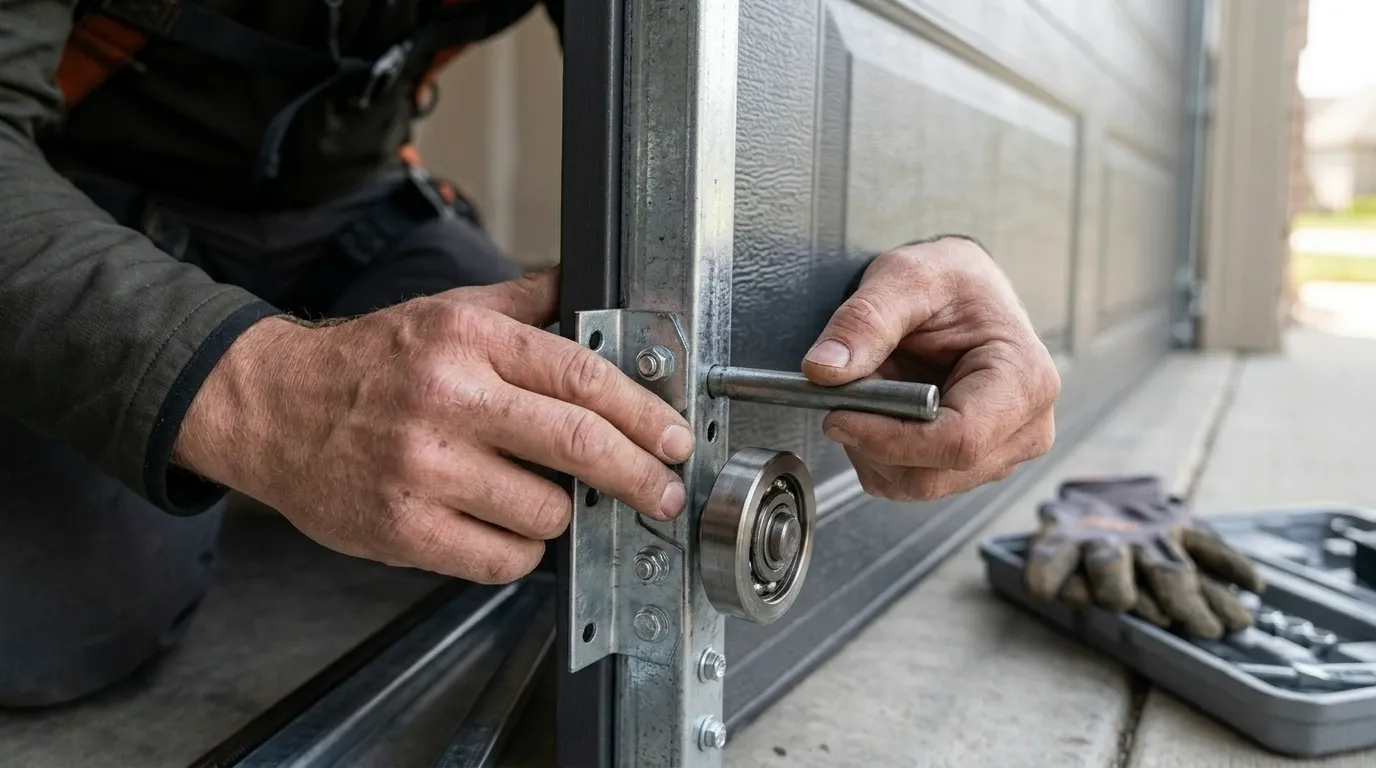
The call we get from Haverford is usually the same: a commercial door that won't lift on the first try in the morning, or one that lifts halfway and stalls. On a steel sectional or a rolling service door, that's almost never the opener. It's a spring that's lost tension overnight in the cold, or a torsion shaft that's binding because the bearing plate has worn loose.
The reason this shows up so often in Haverford specifically is the building stock. The area's buildings run to a median year built of about 1951, which puts a lot of the commercial and light-industrial overhead doors here on original or first-generation replacement hardware - torsion springs sized for lighter cycle counts than what a working bay door sees today. A door that was fine in September starts sticking hard once the shop unheated overnight drops near freezing, because the steel in an old spring gets stiffer and more brittle with age and cold both.
This region sits in a cold-severe climate band, and that matters more for a commercial door than a residential one because commercial doors cycle more times a day and carry heavier panels. Cold steel fatigues faster under repeated load, and a spring that's already 15 or 20 years past its rated cycle count doesn't have much margin left. That's the mechanical half of it.
The other half is scheduling. Haverford is about 16 miles from the Cherry Hill shop, so there's no walk-in counter five minutes away - a same-day fix here means routing a truck that's already carrying stock for a run out this way, not swinging by on a whim. For a business that can't operate with the bay door down, that distance is worth planning around rather than discovering on the day the spring lets go.
We won't pretend every failure is a quick fix, either. If the track is bent from a forklift strike or the hardware's rusted through at the mounting bracket, that's not a same-visit repair - it needs a return trip with the right bracket and, sometimes, a full section.
For the hardware most common in buildings from this era - torsion springs in standard commercial sizes, extension spring sets, shaft bearings, cable drums, and the heavier-duty rollers that older steel sectional doors use - the truck carries what covers most calls in one visit. Galvanized cable and standard track brackets are stocked too, since corrosion from cold-weather cycling is a repeat issue on doors this old.
Where we don't carry stock is anything proprietary to a specific rolling-door or high-cycle operator brand installed after the fact - some of those parts are special-order only, and if that's what's failing, the honest answer is a return visit once the part's in hand rather than a promise we can't back up on-site. We'd rather tell you that up front than have a truck sit idle waiting on a part nobody carries.
A generic commercial garage door page could say all of the above about a hundred towns. What makes it true for Haverford specifically is the combination: a building stock centered on 1951, a cold-severe climate that shortens the working life of old spring steel, and a service radius of 16 miles that means the fix has to be planned for, not walked to. Swap in a town with newer commercial construction or a mild climate and the failure mode changes - the spring isn't the weak point anymore, or it doesn't fail on the same schedule.
Haverford's median household income, at $127,157 across roughly 18,192 households in the area, also tends to mean commercial tenants who'd rather pay for a right first-time fix than limp along on a rigged workaround - which is part of why we stock for the hardware era this area actually has instead of a generic parts list. For the rest of what the shop covers, see the main commercial page for Cherry Hill; for other towns nearby, see the Haverford area page.
Haverford is about 16 miles from Cherry Hill. We don't operate a branch out there, so a visit means routing a truck from the shop rather than a local walk-in call. We don't quote a response time here beyond what we can actually plan for on a given day.
Yes - standard torsion springs, extension springs, shaft bearings, cable, and heavy-duty rollers are stocked on the truck, since that's the hardware most common on buildings from this area's era. Proprietary parts for some newer rolling-door operators are special order.
This area sits in a cold-severe climate band. Cold steel is stiffer and more prone to fatigue, and a spring near the end of its cycle life loses tension faster in the cold than it would in mild weather. Doors that cycle heavily, as commercial doors do, feel this first.
Call now or request a free quote - same-day service on most repairs, upfront written pricing.