Cherry Hill, NJ · Garage Door Service
Broken torsion spring in Cherry Hill? We explain why 1950s-era housing stock and cold winters wear springs out faster, and what actually drives the repair cost.
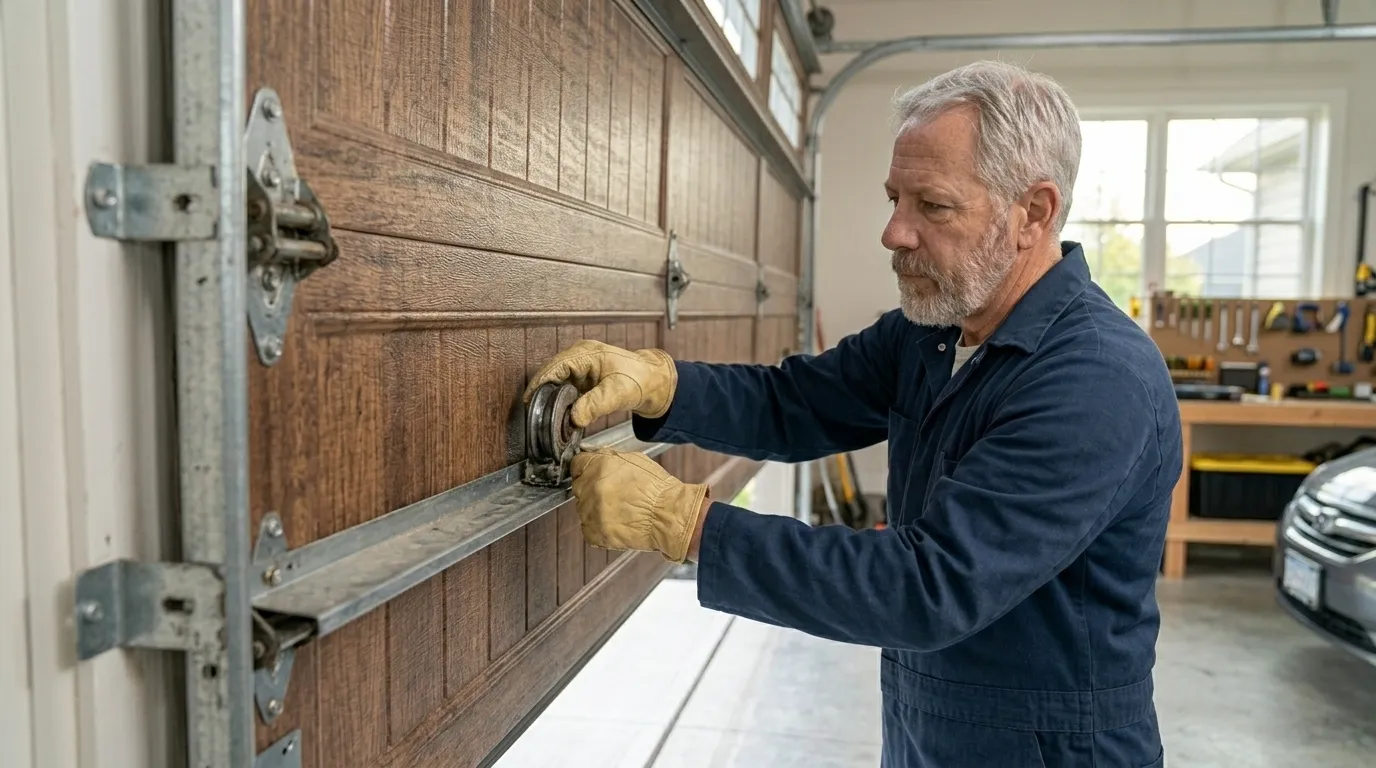
A broken torsion spring is a wound-up steel coil that snaps under its own tension, and it's not a job for a ladder and a wrench. We clamp the shaft, back off the winding cones with steel bars, and pull the old spring off the header bracket without letting the shaft whip. On most single doors that's one torsion spring sized to the door weight; on a lot of the double doors we see out here, it's two matched springs that both have to come off and go back on together, or the door racks sideways the first time it opens.
We measure wire gauge, coil diameter, and length off the old spring rather than guessing from a chart, because a spring that's close but not exact will either strip the opener gears or leave the door too heavy to lift by hand if the power goes out. Once the new spring is wound to the right number of turns for that door's weight, we run the door through a full cycle, check that it balances at roughly the halfway point when disconnected from the opener, and lubricate the coil so it doesn't bind on the shaft. That balance check matters more than people think - a door that's out of balance by even a few pounds puts the strain right back into the opener and the cables within months.
Housing across this service area was built mostly between 1938 and 1997, with the typical home dating to around 1956, and that pre-1960 stock shows up in 86 named areas across the territory. Doors and openers get replaced over the years, but the torsion hardware - the shaft, the brackets, the spring sizing itself - often stays original or close to it, sized for a lighter door than what's hanging on it now.
The climate does the rest. This area sits in a cold band on the severe end, which means the spring steel goes through a real freeze-thaw swing every winter. Steel that contracts hard in January and expands again in a warm spell fatigues faster than the same spring would in a mild climate - the coil doesn't snap from one big load, it snaps from thousands of small temperature cycles on top of years of daily lifts. That combination - older torsion hardware sized decades ago, sitting through severe cold every winter - is why spring failure here tends to happen in clusters during the coldest stretch of the season rather than spread evenly through the year.
We don't have a fixed number to put in this space that would hold true across every door, so we're not going to invent one. Cost depends on whether you need one spring or two, the wire gauge and length the door actually calls for, and whether the cable drums or bearing plates need to come off with the old spring. What we can tell you is how we price it: we diagnose the door in person, quote the spring job itself before any work starts, and we don't fold in a replacement pitch unless the springs are actually the smaller problem next to a cracked panel or a worn-out opener.
Across the households in this service area - 369,881 total, with 162,613 of those owner-occupied houses - median household income runs around $100,130. That's context, not a promise about your bill, but it's part of why we quote the spring repair as its own line item instead of bundling it into a bigger sale. A spring job is usually one of the more predictable repairs a garage door needs, precisely because the part itself is standard - it's matching it to your door's weight that takes the judgment.
The most common version: the door won't budge, the opener motor hums or clicks but nothing moves, and if you look up at the shaft above the door you'll see one side of the spring gapped open where it should be a tight coil. Sometimes it's louder - a bang like a car backfiring, usually first thing on a cold morning when the door gets used for the first time that day.
A quieter version shows up first: the door feels heavier than it used to when you lift it by hand, or the opener starts straining and reversing partway up. That's a spring losing tension before it fully breaks, and it's worth calling about before it snaps rather than after, since a spring under partial tension can still let go while someone's hands are on the door.
One thing we won't do is tell you a spring repair will fix a door that's actually dragging on bent track or binding on a warped panel - that's a different job, and springs sized for a door that isn't moving freely will wear out again fast. If the door is sticking on the frame or one side drags, say so when you call.
If the opener runs but the door doesn't move, or moves only a few inches before stalling, that's almost always the spring, not the motor. A dead opener usually stays silent. Look up at the spring above the door - a visible gap in the coil confirms it. Openers rarely fail at the same time a spring breaks, even though it can feel that way.
On a double spring setup we don't recommend it. Springs age together under the same cycles and cold winters, so the one still holding is usually close behind. Mismatched spring age means uneven lift, which strains the opener and the new spring faster than if both were replaced at once.
It's not safe to force the door open by hand or with the opener once a spring is broken - the door can drop suddenly. It's fine to leave the door closed and unused until it's fixed, but don't try to drive the car out from under it.
By Neighborhood
We also handle spring repair in these Cherry Hill-area suburbs.
Call now or request a free quote - same-day service on most repairs, upfront written pricing.