Cherry Hill, NJ · Garage Door Service
Commercial garage door repair in Levittown, NJ, where most buildings date to the 1950s. Cherry Hill Garage Door Pros drives in from 18 miles away for the job.
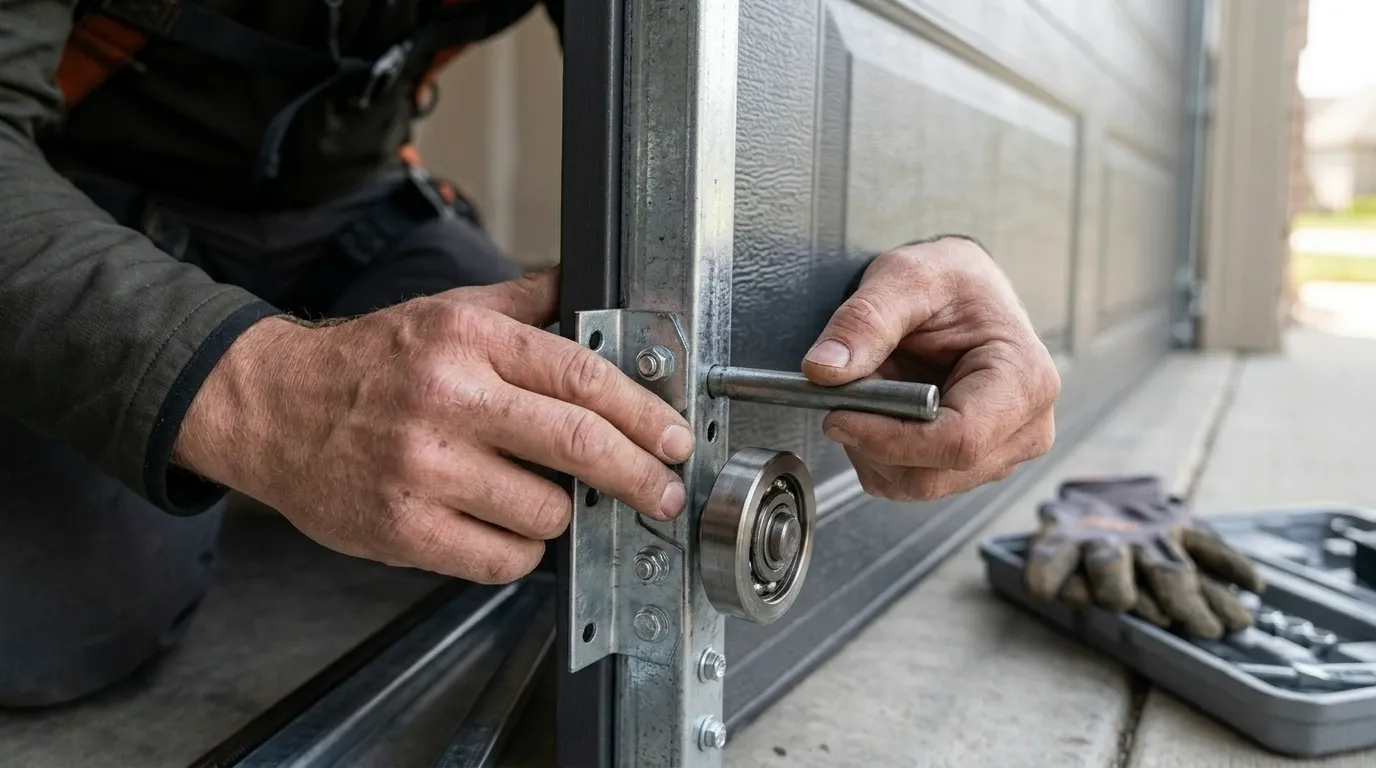
The service calls we get from Levittown almost always start the same way: a commercial overhead door that won't roll past the halfway point, or one that slams down because a cable jumped its drum. That's not random. The buildings here went up in the same wave as the housing around them - median build year 1956, with most of the area's commercial and light-industrial stock raised before 1960. Doors installed in that era ran on steel track sized for lighter wood or single-layer steel panels, not the insulated sectional doors many owners have since bolted onto the same frame. The torsion springs behind those old jambs were wound for a lighter door, so when a business upgrades the panel and keeps the original spring, the spring works overtime until it snaps. Add in a severe cold climate band, where steel track contracts and lubricant thickens through the winter months, and you get the two failures we see most on this hardware: a stuck door in January and a broken spring by February.
A jammed commercial door is not a place to improvise. Springs on commercial doors carry more tension than residential ones, and the older hardware common in this area doesn't behave the way newer systems do. We won't talk you through adjusting a torsion spring over the phone, and we don't recommend it even with the right tools, because the failure mode here isn't a scratch, it's a broken hand. Where DIY does make sense: swapping worn rollers, tightening loose track brackets, or replacing weatherstripping that's cracked from repeated cold. Those are low-risk jobs and worth doing yourself if you're comfortable on a ladder. One honest limitation: if your panel is an older, discontinued profile from the pre-1960 stock common here, we may not be able to match it exactly, and a full panel swap sometimes ends up cheaper and faster than hunting down an obsolete part.
We run this job out of Cherry Hill, about 18 miles from Levittown, so there's no local branch or drop-in counter here - we schedule the visit and drive the truck out with the parts for your door already loaded based on what you tell us on the call. That distance is why we ask for the door's age, panel type, and whether it's ever had the spring replaced before we show up; on hardware this old, guessing wrong means a second trip. For a look at how we cover the rest of the towns near here, see our page for Levittown and the surrounding area. If you're comparing this against a straight residential fix, our Cherry Hill commercial garage door page covers what we do across the wider service area, including new installs.
A national repair chain sends whoever's closest and hands them a generic parts kit. That doesn't work well here. Levittown's roughly 18,140 households sit inside a wider service area of 369,881 households where the median income is $100,130 - but locally it runs higher, at $101,619, which tends to mean owner-run shops and small offices that fix a door rather than replace the building. Those owners want a repair that respects the original hardware, not a rebuild that assumes 2020s track and a modern spring cage. A tech unfamiliar with a market built mostly before 1960 will quote a job assuming standard parts, then find the drum, the shaft size, or the track gauge doesn't match anything on the truck. That's the failure we get called to fix after the fact: a door that's been half-repaired with the wrong-size roller, still binding, now with a second visit's labor cost stacked on the first.
Most of the area's buildings, like the housing around them, went up around 1956, with the bulk of the stock raised before 1960. That means older track gauges and torsion springs sized for lighter panels than what's common today.
No. We run out of Cherry Hill, about 18 miles away, and schedule the drive out as part of routine coverage. There's no drop-in counter here, so we ask for door details on the call to load the right parts before we come.
We don't recommend it. Springs on commercial doors carry more tension than residential ones, and the older hardware common in this area doesn't behave the way newer systems do. Low-risk jobs like roller swaps or weatherstripping are fine to DIY; spring work isn't.
A generic quote usually assumes standard modern parts. On pre-1960 hardware the track gauge or shaft size often doesn't match, so the job needs a second trip or a different part than planned. We ask for the specifics upfront to try to avoid that.
Call now or request a free quote - same-day service on most repairs, upfront written pricing.