Cherry Hill, NJ · Garage Door Service
Levittown homes date to 1956 - original torsion hardware is common. Cherry Hill Garage Door Pros drives 18 miles out for tune-ups that catch it before it fails.
Most of Levittown went up around 1956, and a lot of what's holding those doors up has never been swapped out. If the house hasn't had a garage door job done on it, the torsion spring, the rollers, and probably the drum and cable are original to the build. That's close to seventy years on steel and cable that was rated for maybe ten to fifteen years of daily cycles before fatigue sets in.
The failure mode on hardware this old isn't always a snap. Sometimes it's a spring that's lost enough tension that the opener is doing all the lifting, which burns out the motor early. Sometimes it's a roller that's worn oval instead of round, binding in the track and pulling the whole door sideways a quarter inch every time it opens. Neither of those looks like an emergency until the day it is one.
Cold makes all of this worse. Steel contracts, grease in old bearings stiffens up, and a spring that was barely doing its job in October can bind or snap on the first hard freeze. None of this is unique to any one house, but on a street where most of the doors came from the same building push in the same year, we see the same failure show up on multiple houses within a season of each other.
We don't guess at what's original and what's been replaced from the street. That's what the visit is for.
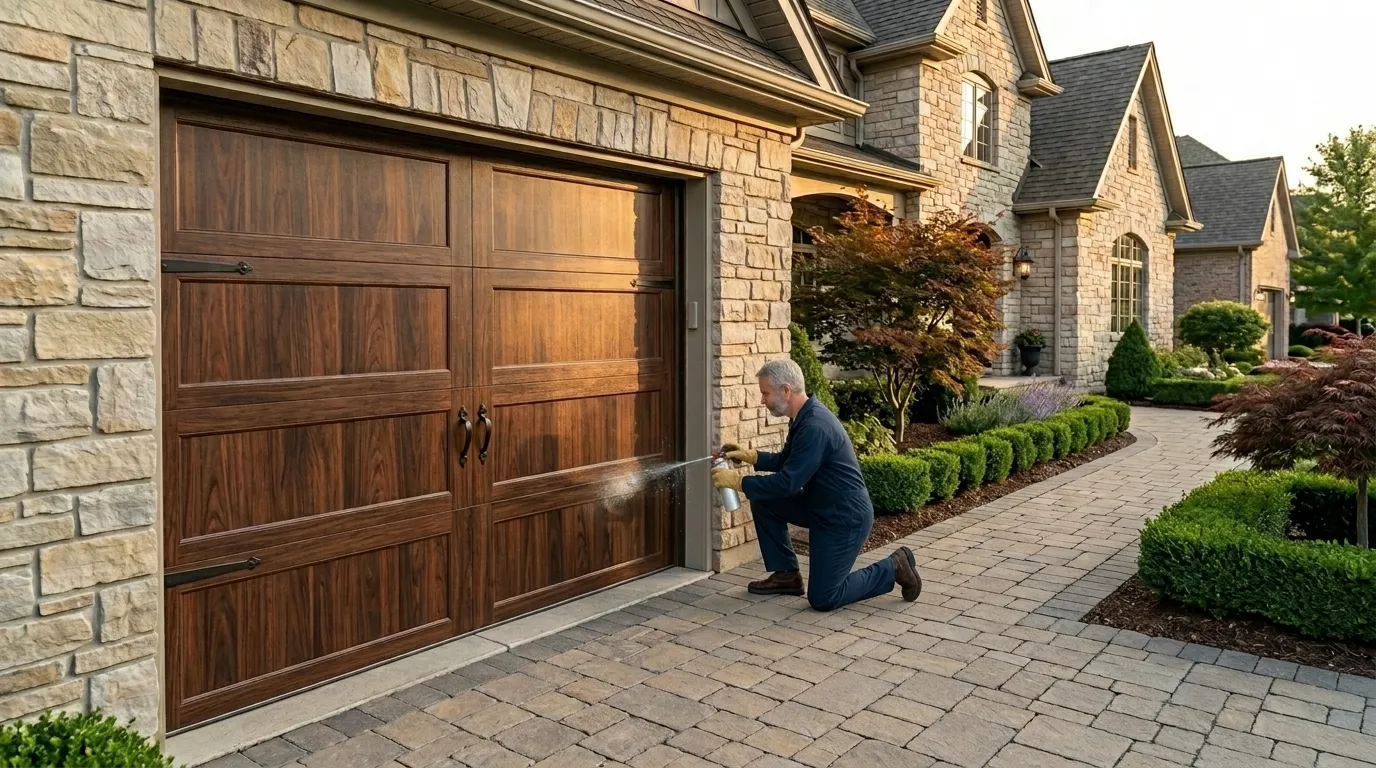
You can lubricate hinges and rollers yourself, and you should - it's five minutes with the right spray and it buys the hardware time. What you shouldn't touch is the spring. A torsion spring holds enough stored tension to break a wrist or worse, and on hardware that's been sitting since 1956, corrosion inside the coil can make it fail without warning the moment you put a wrench near the winding cone.
Cables are the same story. If a cable is fraying - you'll see individual strands sticking out like a frayed rope - that's a sign the whole cable needs replacing, not a spot repair. Same goes for a bent track: bending it back by hand usually just moves the bind somewhere else.
What's worth doing on your own: wipe down the tracks, check that the door reverses when it hits an object, and look at the weatherstripping at the bottom for cracking. Anything involving the spring, the cable drums, or the torsion tube is where a seventy-year-old fastener can strip or a corroded coil can let go under load. That's the line.
Cherry Hill Garage Door Pros covers Levittown from Cherry Hill, about 18 miles out. That distance is part of why maintenance visits are worth scheduling ahead rather than waiting for a breakdown - a planned tune-up means the truck is already routed through the area, instead of a same-day scramble for one door.
A maintenance visit covers the spring tension, the track alignment, the roller and hinge wear, the cable condition, and the opener's force and travel settings. On a house with original 1956-era hardware, that's usually where we find the wear first - not the opener, which tends to get replaced on its own schedule, but the mechanical parts nobody thinks about until they bind.
We'll tell you straight if a part is close enough to failure that it's not worth greasing and revisiting in six months. Sometimes the honest answer is to replace the spring now rather than schedule a second visit for the same door.
A generic tune-up misses what's specific to this stretch of housing. With 18,140 households in this pocket and a median build year of 1956, a large share of the doors here are carrying hardware from the same production run - which means the same wear pattern shows up across a neighborhood in the same year, not spread randomly the way it would in a mixed-era subdivision.
Median household income here is $101,619, which tells us something too: most owners can afford to maintain rather than defer, but a lot of original hardware still gets ignored simply because nobody flagged it as old. A door can look fine and open fine right up until the spring that's been carrying seventy years of cycles finally lets go.
We don't stock a shelf of parts sized for 1970s or 1990s hardware and hope one fits a 1956 door. When the part is genuinely obsolete, that's a straight conversation about replacement rather than a repair that won't hold.
If the house hasn't had a garage door replaced or serviced, the spring, rollers, and cable drums are likely original to a build year around 1956 - pushing seventy years old. That's well past the working life torsion hardware was rated for, even with occasional lubrication.
No. We work out of Cherry Hill and drive out to Levittown, about 18 miles each way. That's why scheduling a maintenance visit ahead of time, rather than waiting for a failure, makes more sense here than in towns closer to our shop.
No - a torsion spring holds enough tension to cause a serious injury, and on a spring this old, corrosion inside the coil can make it behave unpredictably even before you touch it. That's one job worth paying for regardless of how simple the rest of your maintenance list is.
Sometimes. If the track, drums, and spring are all original and all showing wear at once, patching one part often just shifts the failure to the next. We'll tell you when replacement is the better spend instead of stacking repairs on hardware near the end of its life.
Call now or request a free quote - same-day service on most repairs, upfront written pricing.