Cherry Hill, NJ · Garage Door Service
Northampton homes date to about 1980, which means steel rollers on steel track, not the nylon rollers on newer builds. Here's what that means for repair.
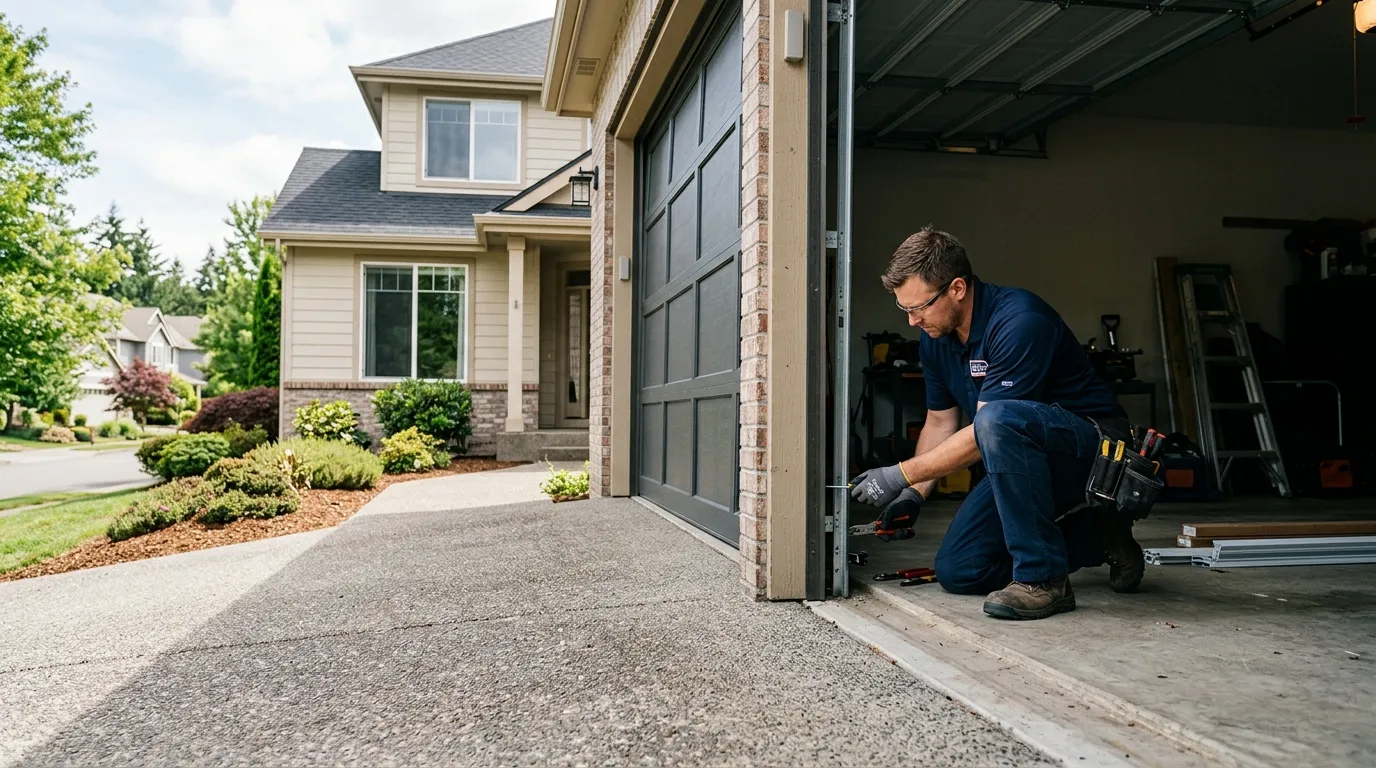
We don't have a set price to quote you here, and any number we gave you without seeing the door would be a guess dressed up as a fact. What we can tell you is what drives the cost on a house like yours: Northampton's housing stock centers on 1980, which means most doors still running are steel, two-panel or three-panel, on steel rollers rather than the nylon rollers that show up on later builds. Steel rollers wear at the roller stem and the bearing inside it, not the roller face, so a tech has to check whether you're replacing rollers alone or rollers plus the track they're riding in. If the track has grooved from years of steel-on-steel contact, that's a second line item, not a swap. Ask for the breakdown in writing before the truck leaves, and ask whether the quote assumes steel or nylon replacement rollers - that choice affects both the price and how quiet the door runs afterward.
We run out of Cherry Hill, and Northampton sits about 19 miles out, which puts it toward the far edge of a day's route rather than the middle of it. That doesn't change the work, but it does mean a roller job here gets scheduled as its own stop rather than squeezed between two closer calls. If you're booking, tell us up front whether the door is still operable - a door that still opens and closes, just loud or rough, gives us more flexibility on timing than one that's stuck open or closed. We travel from Cherry Hill for every visit; there's no local branch or standing truck in Northampton, so a same-day slot depends on the route that day, not a promise we can make in general.
A door built around 1980 has usually had one owner's worth of use on its original hardware, and steel rollers on steel track are a durable pairing right up until the bearing inside the roller dries out. Once that happens, the roller stops turning freely and starts dragging against the track instead, which grinds a flat spot into the roller and scores the track rail at the same time. Northampton's median household income, at $153,375, is well above the wider service area's $100,130, and that shows up less in the fault itself and more in what owners tend to do about it - replace the full roller set and inspect the track in one visit instead of swapping one roller and hoping the rest hold. With 14,086 households in town, this isn't a rare complaint, it's a predictable one tied directly to how old the hardware on most doors here actually is.
Roller replacement on its own doesn't usually take the door out of service for more than the length of the visit - rollers come out and go back in one at a time, so the door is never fully disassembled the way it would be for a full panel swap. The variable is parts. If your rollers are worn enough that the track needs resurfacing or replacing too, and the tech doesn't have the right track length on the truck, that becomes a second trip. On a 1980-era door, track sections aren't always a stock size, so it's worth asking at booking whether the tech is bringing track stock or just rollers, especially if you've already noticed the door binding or jumping the track when it moves.
Swapping a single roller is within reach for an owner who's comfortable disconnecting the door from the opener and working safely around a loaded torsion spring - but that's the honest limit of it. The harder part on a 1980-built door isn't the roller, it's judging whether the track underneath it is still true or has worn enough that a new roller will just wear the same way in six months. That call takes a track gauge and an eye trained on steel wear patterns, not a guess. If you're not confident reading the track, this is one to hand off rather than half-finish - a roller replaced on a bent or grooved track fails faster than the one you took out.
The complaint that brings most Northampton owners to call is a grinding or rhythmic clunk as the door travels, usually louder going up than coming down, sometimes paired with the door hesitating at the same spot on every cycle. That rhythm is the tell: a flat-spotted roller hitting the track once per rotation, not a spring or cable problem, which tends to sound more like a single loud bang or a door that won't move at all. On the steel-roller doors common to this area's 1980-median housing, that grinding sound shows up months before the roller actually fails outright, which is the window worth calling in during, not after.
Steel roller bearings tighten up in cold, and the service area sits in a severe cold climate band, so a roller that's already dry from wear will bind harder and louder in winter than it does in summer. It's the same worn part, just more noticeable when the metal contracts.
Standard steel and nylon rollers are common stock items, but track sections for older doors aren't always guaranteed to be on hand. If your door needs track work along with rollers, ask at booking so the visit is scheduled with the right parts loaded.
If the door itself - panels, hinges, frame - is still sound and it's just the rollers and maybe the track that are worn, replacement rollers are the cheaper and faster fix. Full door replacement only makes sense once the panels or the spring system are also failing.
Call now or request a free quote - same-day service on most repairs, upfront written pricing.