Cherry Hill, NJ · Garage Door Service
Cherry Hill Garage Door Pros services Ardmore, NJ homes built mostly before 1950, with springs and openers sized for older doors, from 15 miles away.
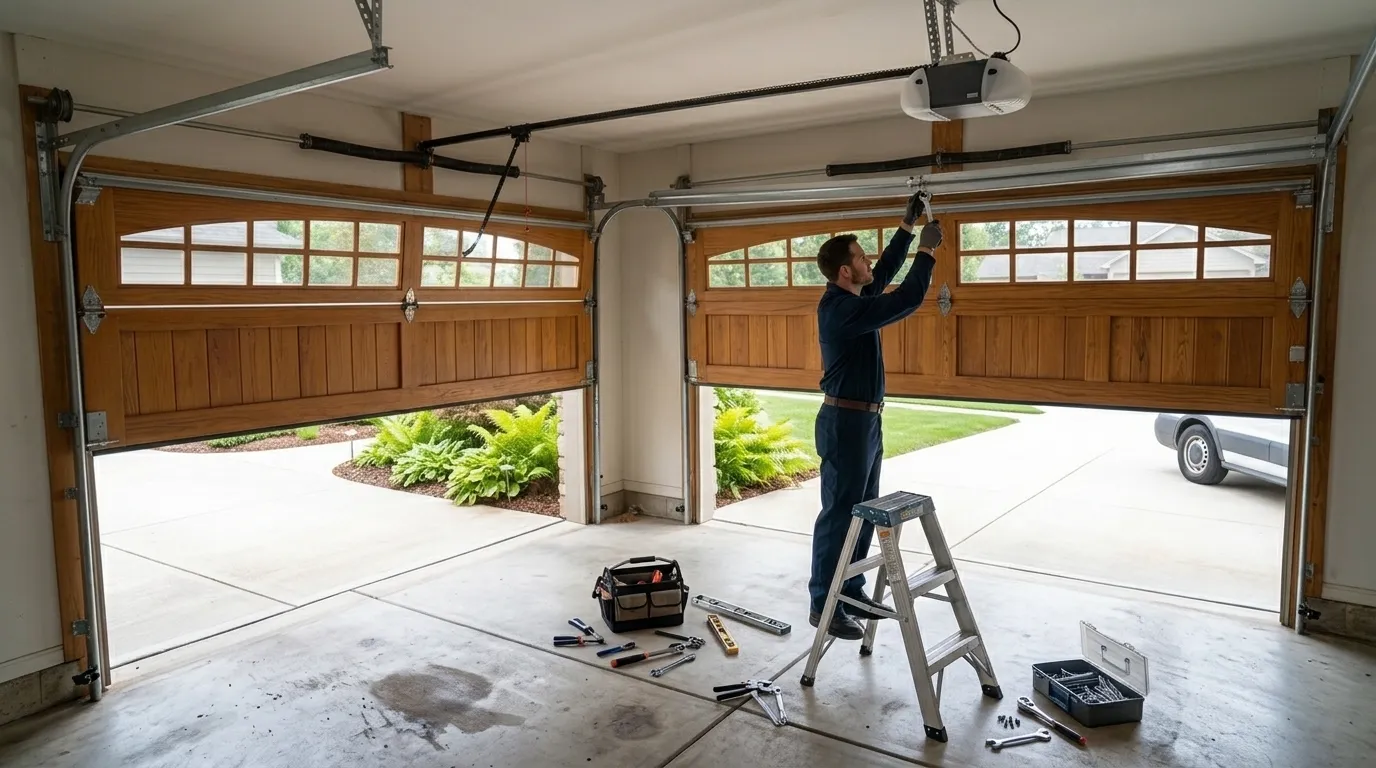
The typical house in this part of Ardmore went up around 1942, a good fourteen years ahead of the 1956 median across the wider Cherry Hill service area. That gap matters more than it sounds. A door built for a 1942 opening usually sits on side-mounted torsion hardware, not the center-mounted setups that showed up on houses built after the war. When we get a call from here, it's rarely a modern extension spring snapping - it's a torsion spring on an old drum that's been re-wound once already by somebody before us, or a track bent from decades of a single roller riding it wrong.
We also hear from owners whose openers are the second or third one bolted to framing that was never meant to hold a chain-drive unit's weight. The original framing in houses this age was sized for a lighter door and no motor at all. So half the opener calls out here start with us checking whether the header board can even take a new unit before we talk price.
It's not all old-house trouble. Some blocks got doors replaced in the last fifteen years and those calls look like anyone else's - a roller worn out, a cable frayed. But the older stock is the majority of what we're called out for.
We don't promise same-day service on calls from Ardmore. We're driving the fifteen miles out from Cherry Hill, and pretending otherwise would be a lie we'd have to walk back on the phone. If your spring goes on a Saturday afternoon, we'll tell you honestly where you land in the schedule instead of guessing.
We don't carry every panel size for pre-1950s doors on the truck. Original hardware from this era sometimes used dimensions that don't match anything a supplier stocks new, and if your door needs a matching replacement panel rather than a full new door, that part may need to be special-ordered - which takes longer than a same-week fix.
And we don't push a spring rebuild on a door frame that's failing structurally. If the header board is rotted or the jamb has shifted enough that the door binds no matter what we do to the spring, replacing the spring is money spent to delay the real job. We'll say so instead of doing the smaller repair and letting you find out in six months.
This stretch of Ardmore has roughly 6,487 households, most of them sitting in houses with a median build year around 1942 - noticeably older than the 1956 median across the broader service area Cherry Hill Garage Door Pros covers, where housing runs from 1938 up through 1997. Median household income here runs about $115,273, above the $100,130 median for the wider area.
That income figure shows up in the kind of work we get asked to do. Owners here more often ask us to replace an opener outright rather than patch the one they have, and more often choose an insulated steel door over a like-for-like wood replacement when the old one finally needs to go. It's not that the door problems are different in kind - a broken cable is a broken cable - it's that the decision after we diagnose it tends to go toward replacement sooner than it might somewhere with a newer housing stock and a tighter budget.
The wider service area sits in a cold-severe climate band, and on a door built in 1942 that matters in specific ways. Steel track brackets fastened to wood framing eighty years ago have usually worked loose from repeated freeze-thaw cycles - not from any one bad winter, but from all of them stacked up. We check bracket lag bolts on almost every older-door call here before we touch the spring, because a spring adjusted against a loose track won't hold its balance for long.
Cold also stiffens old lubricant on original rollers and hinges faster than it does on hardware installed in the last decade, so doors that move fine in September can bind hard by January. On a door this age, that binding puts extra load on a torsion spring that may already be undersized for the door's actual weight, since some of these openings were fitted with heavier doors at some point without anyone re-rating the spring to match. That combination - old track hardware, stiff lubricant, and a spring rated for a lighter door - is the pattern behind most of the winter calls we take from this part of town.
Because we're coming from Cherry Hill, fifteen miles away, and we'd rather tell you the real schedule than promise a window we can't hit. We book Ardmore calls in when we can get there without rushing the job ahead of us, and we'll give you an honest estimate on timing when you call.
Sometimes. Original panel sizes and some torsion drum dimensions from that era aren't always things a supplier stocks new, so a matching replacement part can take longer to source than a same-week repair. We'll tell you up front if your job needs a special order rather than quote a timeline we can't back up.
Often yes, especially on houses here where the original framing wasn't built to carry a heavier chain-drive unit. We check the header board first. If it can't take a new opener without reinforcement, we'll say so before quoting a repair that wouldn't hold up anyway.
Yes. Original hardware from the 1940s tends to have looser track brackets and stiffer old lubricant after decades of freeze-thaw cycles, which is common in this climate band. That combination is behind most of the binding and hard-start problems we see on winter calls from older houses here.
Call now or request a free quote - same-day service on most repairs, upfront written pricing.