Cherry Hill, NJ · Garage Door Service
Torsion spring and opener repair for Cherry Hill homes built mostly before 1960. We know the old hardware and the cold-season strain that breaks it. Call for a fix.
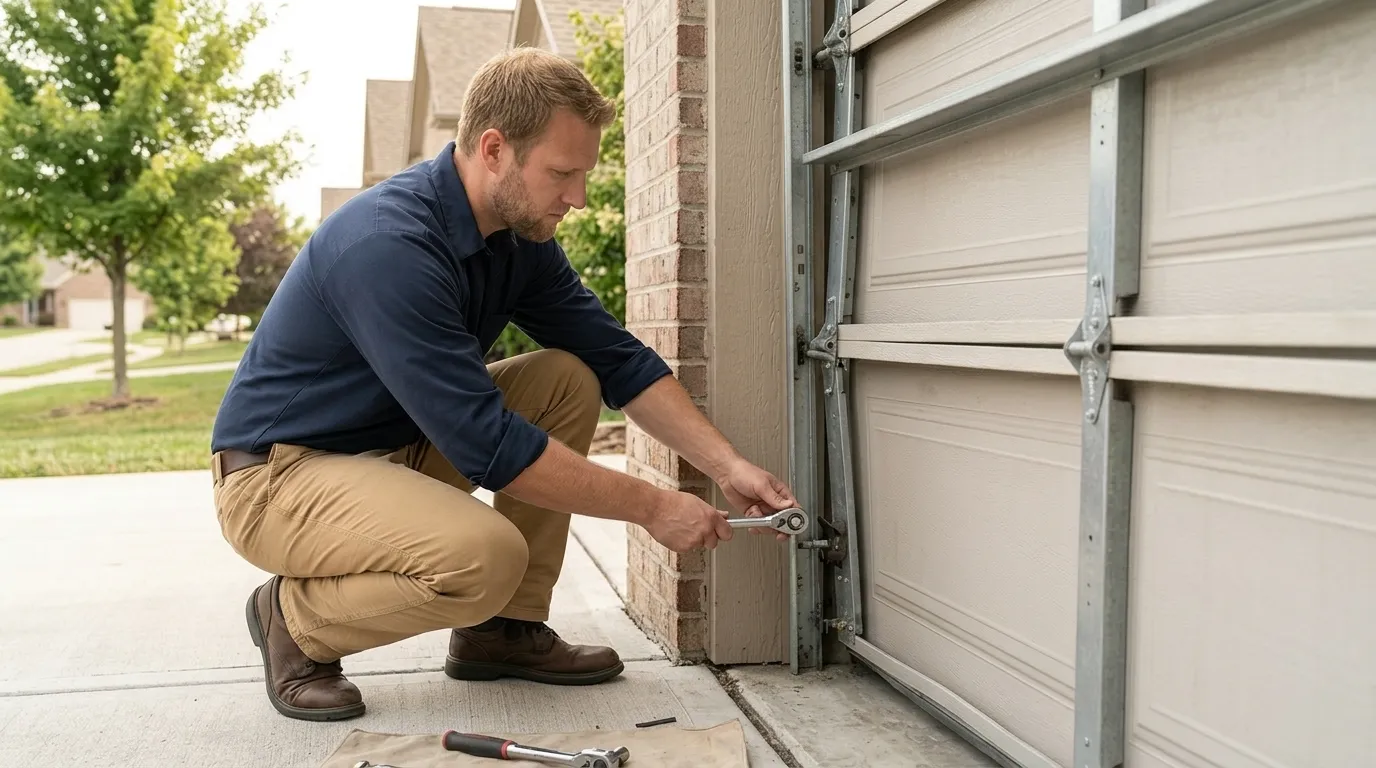
Most calls start the same way: a door that won't move, or one that moves and then drops. We open the panel, check the torsion spring wind, and look at the drum and cable before we touch anything else. In a lot of Cherry Hill houses - the median build year here is 1956 - that spring is on original side-mounted hardware, not the center torsion bar you'd find in anything built after the 1980s. That changes the repair. We measure wire gauge and inside diameter before we order a replacement, because guessing wrong on an older size means a second trip.
If the opener is the problem, we test the logic board, the travel limits, and the safety sensors in that order, since a bad sensor reads to a homeowner as "opener's dead" when it's a $20 part. We don't replace a spring system that's still within its cycle life just because the door is noisy - most noise on a house this old is a dry roller or a bent track bracket, and that's a cheaper fix. We tell you which one it is before we quote anything.
Cherry Hill's housing stock runs mostly 1938 to 1997, with a median build year of 1956, and that decade is exactly when a lot of one-piece and early sectional doors went up on steel that wasn't galvanized to today's standard. Add a cold-severe climate band and you get a specific failure pattern: the spring steel contracts through winter, the lift cable stretches at a different rate than the drum it's wound on, and by February a door that worked fine in October needs real force to lift.
We see this most in the parts of town where the original 1950s-60s tract housing never had the torsion hardware swapped out. The garage itself is usually unheated and unwrapped, so the temperature swing inside it tracks the outside air almost exactly - there's no thermal buffer the way there is in the living space. That's not a defect in any one door. It's what happens when 1950s steel sits through sixty-plus New Jersey winters without the hardware ever being upgraded.
We don't have a flat number to hand you here, because what you pay depends on what's actually broken and whether the part is a stock size. A standard torsion spring for a double door built to modern spec is a same-day part. A spring sized to hardware from a house built in the 1950s or 60s - smaller shaft diameter, different wind - sometimes isn't something we carry on the truck, and that adds a day or two while we source it.
Opener repairs are usually the cheaper end of the visit; full spring and cable jobs are the higher end, especially on double doors where both springs get replaced together rather than one at a time, since a mismatched pair puts uneven load on the shaft. We'll tell you on site which category your job falls into before we start, and we won't replace parts that aren't the problem just to pad the ticket.
The one we hear most from Cherry Hill: the door opens partway, stalls, and either reverses on its own or needs a shove to keep going. That's almost always a spring that's lost tension - not the opener motor, even though the motor is straining and making noise like it's the one failing. A second common one: the door comes down fast at the end of its travel instead of settling, which points to a cable that's stretched or a drum that's slipping.
A door that's completely silent and won't respond to the wall button or remote is more often a dead capacitor or a tripped breaker than a spring problem - check the breaker first, it costs you nothing. If the door is heavy to lift by hand with the opener disconnected, that's spring tension, and it's not a DIY fix; torsion springs under load have put people in the ER. Leave that one to a call.
Cold contracts spring steel, and Cherry Hill's climate band is rated cold-severe, so a spring that was marginal in fall often crosses the line into
Call now or request a free quote - same-day service on most repairs, upfront written pricing.