Cherry Hill, NJ · Garage Door Service
Cherry Hill Garage Door Pros travels 16 miles out to Bryn Mawr, NJ, where most houses date to the early 1950s and still run original torsion hardware.
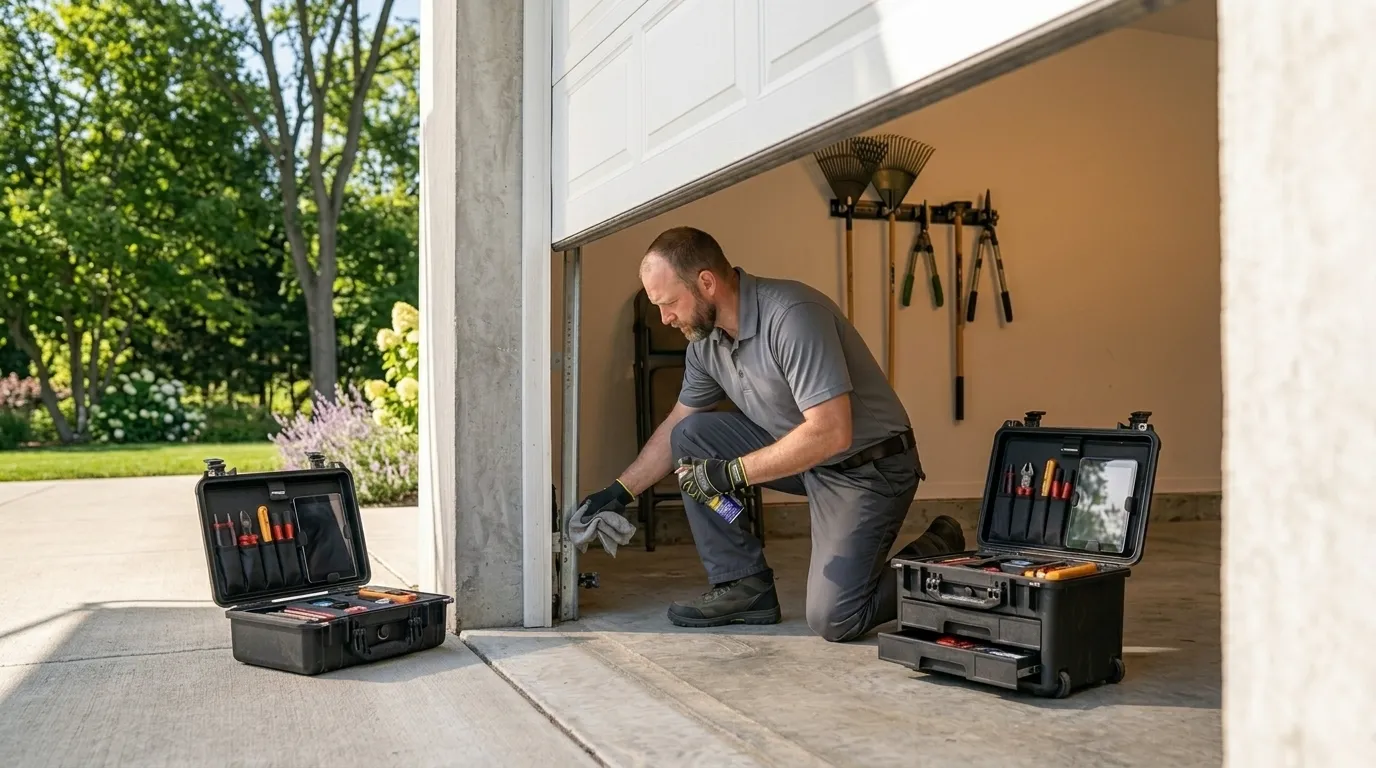
Bryn Mawr sits about 16 miles out from our Cherry Hill shop, and the calls we take from here look different from the newer subdivisions closer to us. With a median build year of 1952 and only 1,881 households in the area, this is a smaller, older pocket of the region. Most of what we see is original hardware - torsion springs that were never upgraded, steel or wood panel doors from before the era of foam insulation, and openers that have been swapped once, maybe twice, since the house was built. We get a lot of "the spring just snapped" calls, and a fair number of "the door won't go all the way down anymore" calls, which is usually a track or roller problem on a door that's outlived its original hardware. Median household income here runs $87,218, noticeably below the $100,130 median across our wider Cherry Hill service area, and that number matters more than it sounds like it should - it's often the difference between someone choosing a spring replacement over a full door swap when either could technically work. We price the job on what's actually wrong, not on what the neighborhood looks like.
We don't keep a depot or a truck stationed in Bryn Mawr. Every job here starts as a drive from Cherry Hill, which means we're not the outfit to call if you need someone standing in your driveway in twenty minutes. We schedule the trip; we don't pretend to have a local presence we don't have. We also won't replace one spring on a double torsion-spring door and leave the second one - if one side is original from 1952, the other side is on borrowed time too, and we'll say so instead of doing the cheaper half-job. And on some of the oldest wood-panel doors out here, if the frame itself has racked or rotted, we're not going to force a new door into a bad opening - that's carpentry work outside what we do, and we'll tell you plainly when a repair isn't worth doing before we start.
The housing stock in this part of the service area runs from 1938 to 1997, but Bryn Mawr's own median sits at 1952 - squarely in the postwar building years, older than a lot of what surrounds it. That matters for garage doors specifically, because 1952 predates almost every hardware standard homeowners assume is universal. Sectional doors with modern galvanized track weren't common yet; a lot of what went up here started as single-panel doors on side-hinge or early overhead track hardware, later retrofitted piecemeal as parts failed. The region also sits in a cold-severe climate band, which over seventy-plus years means repeated freeze-thaw cycles working on steel track brackets, wood jambs, and old lift cables. A door built for 1952 conditions was never engineered against decades of that cycling, and it shows in the fasteners and the frame long before it shows in the panel itself.
On a house from around 1952, the door you're looking at is rarely the door the house was built with, but the bones underneath often are. We see torsion tube setups mounted on brackets that were never meant to carry the heavier insulated sections some owners have added over the years, which puts uneven strain on the springs and shortens their life. Cold-severe winters push moisture into old wood jambs, and that swelling and shrinking loosens the track alignment a little more every season, so a door that used to run quiet starts grinding on one side. Non-insulated panels from that era also mean bigger temperature swings inside the garage itself, which stiffens the springs in the cold and makes an already-old torsion system work harder right when it's most likely to fail. None of this is dramatic on its own - it's just seventy years of small stress adding up in a house that was built solid but not built for the hardware it's carrying now.
Cold tightens steel springs and can make old cables less flexible, and in a cold-severe climate like this one that effect is real, not imagined. On a door with original 1950s-era torsion hardware, that stiffness shows up as harder lifts and louder starts, especially first thing in the morning before anything's warmed up.
No. We run every Bryn Mawr job from our Cherry Hill shop, about 16 miles away. We don't stage a truck or stock parts locally, so we schedule the trip rather than promising a same-hour arrival we can't back up.
Depends what's failing. A spring or a track can usually be repaired on even a 1952-era door if the frame and panel are sound. If the panel itself is rotted or racked, or the opening has shifted, replacement usually costs less over time than chasing repairs on a door that's fighting its own frame.
Call now or request a free quote - same-day service on most repairs, upfront written pricing.