Cherry Hill, NJ · Garage Door Service
Eddington homes date mostly to 1958, meaning older torsion hardware and single-panel steel doors. Cherry Hill Garage Door Pros travels 11 miles to fix what that era of construction breaks.
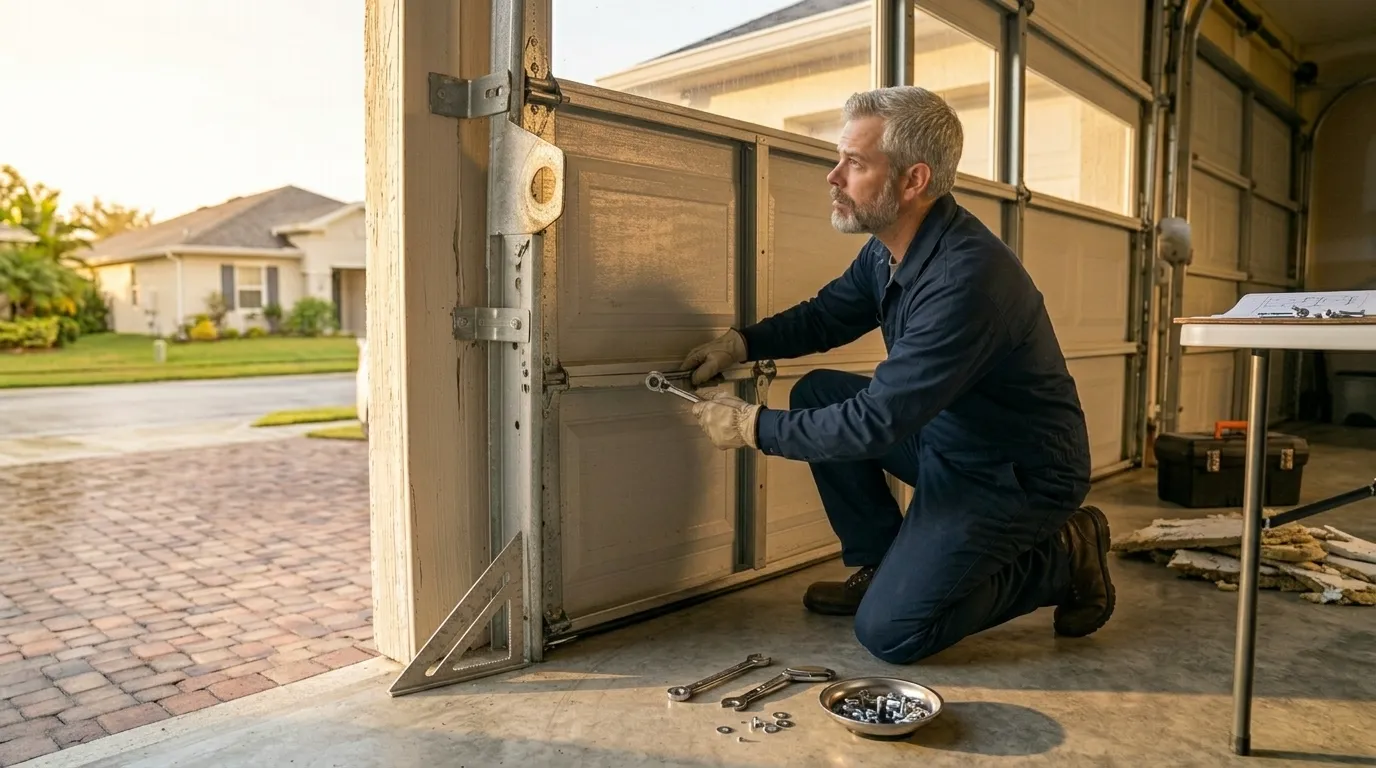
Eddington sits about 11 miles out from our shop in Cherry Hill, and the calls we get from this pocket of the service area lean a certain way. With 686 households here, it's a small enough area that the housing pattern is consistent block to block, and that pattern is 1958 construction. That means original garage doors that have outlived a couple of openers, or doors that were swapped once in the 80s or 90s on hardware nobody upgraded since.
Most calls are torsion springs that finally give out after decades of cycling, and tracks that have worked loose from framing that's settled with the house. We also hear from folks whose openers are newer than the door itself - someone bolted a modern opener onto a 1960s door and the door still fights it because the springs were never rebalanced to match. Median household income here runs $107,727, and what we notice is that owners in this range tend to call before a spring snaps rather than after, once they hear the door start groaning on the way up.
We don't keep a truck stationed in Eddington. Every job here means a drive from Cherry Hill, so we're not the outfit to call for a same-hour lockout unless it's already on our route. We also don't try to force a repair on a door that's past it - if the panel is rusted through or the track is bent beyond straightening, we'll tell you replacement costs less over five years than another patch job, even if that's not what you called to hear.
We don't install openers rated for door weights they can't handle, and we won't quote a job blind over the phone without seeing the spring size and track condition in person. Doors from the 1958 era vary enough in width and hardware spec that a phone estimate is a guess, not a quote.
The median year built in this pocket of the service area is 1958, which puts it right in the middle of the broader area's 1938-1997 range, but tighter - this is a place where houses went up over a shorter stretch than most of the 86 named areas we cover. That consistency matters. It means the garage stock here is more uniform than in areas with a wider mix of decades: mostly original openings sized for the steel doors of that era, mostly side-mounted torsion setups if they've been upgraded at all, and a fair number still running extension springs strung along the horizontal track, which was standard before torsion took over as the safer default.
At $107,727 median income, Eddington households sit above the broader area's $100,130 figure, which tracks with what we see on site - more owners here have already put money into an opener upgrade, fewer are running the original 1958 unit, but the door and track underneath the opener are often still the originals.
A 1958 door on original hardware wasn't built to today's panel widths or insulation standards, and in a cold-climate area like this one, an uninsulated single-layer steel door lets a garage go as cold as the outside air. That's not a comfort complaint most people call about - it's a hardware complaint. Cold makes steel contract, lubricant thickens, and a spring that's borderline anyway is more likely to snap on a January morning than a July afternoon.
What we actually find on these calls: extension springs stretched past safe tension because nobody replaced them on schedule, rollers worn oval instead of round from thirty-plus winters, and track bolted to framing that's shifted just enough to bind the door on one side. None of that is unique to Eddington, but the concentration of it is - when most of the houses on a street went up within a few years of each other, the doors fail on a similar timeline too.
No. We work out of Cherry Hill and drive to Eddington for jobs, about 11 miles each way. We don't advertise a local depot or a guaranteed response window for this area - we schedule the drive like any other call on the route.
Original doors from that era often ran on extension springs, which lose tension gradually and unevenly over decades. If one side has stretched more than the other, the door feels heavier and can tilt when it opens. That's a spring adjustment or replacement, not something to force through repeatedly.
Depends on the panel and track condition. If the steel is rusted through or the track is bent, replacement usually costs less over time than repeated patches. If it's just springs, rollers, or a bent bracket, repair is the right call. We'll look at the actual door before recommending either.
Call now or request a free quote - same-day service on most repairs, upfront written pricing.