Cherry Hill, NJ · Garage Door Service
Serving Plymouth from Cherry Hill, 19 miles out. Doors here mostly date to the mid-1960s build wave - different hardware, different failure points than the older city stock.
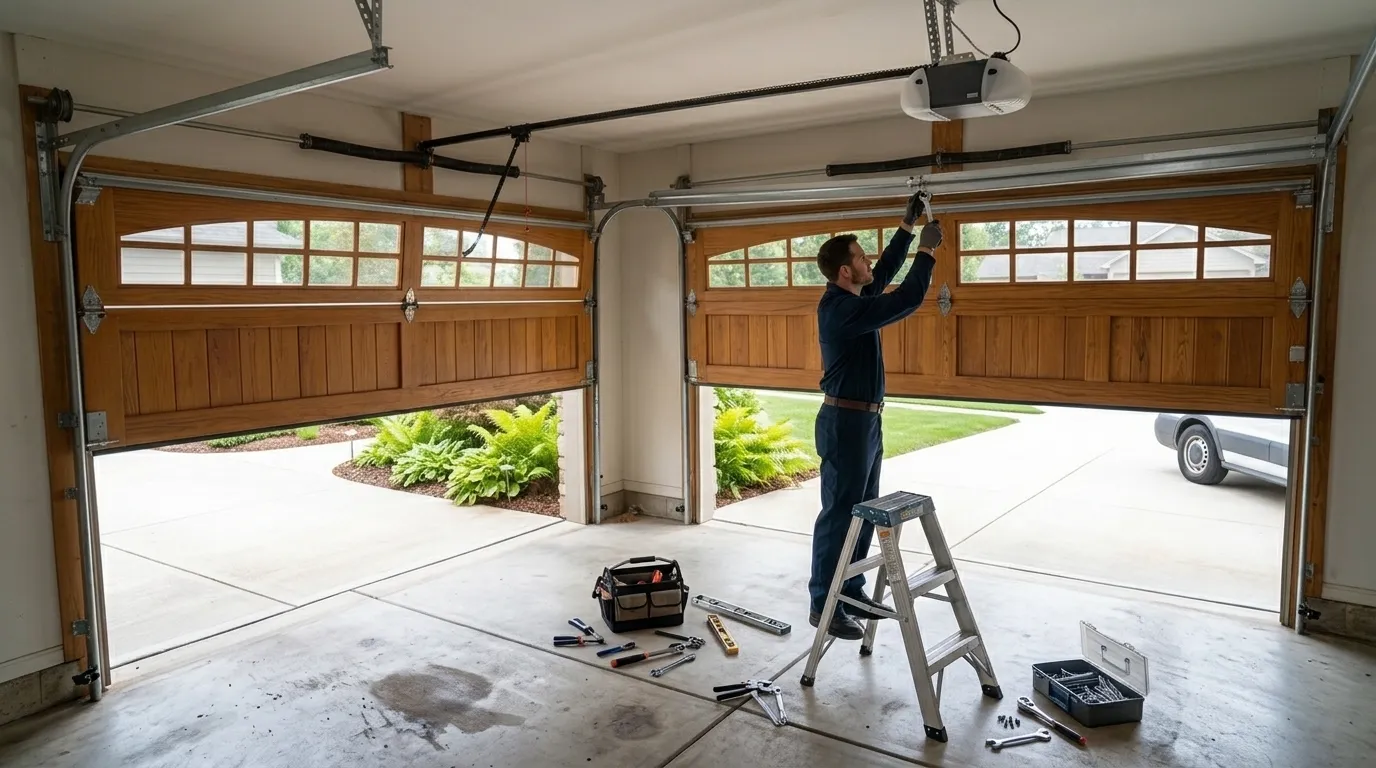
Plymouth's housing mostly went up around 1966, which puts it a decade newer than the 1956 median across the wider Cherry Hill service area. That decade matters. Houses from this build wave usually came with wider sectional steel doors instead of the older wood-panel swing-up or single-piece tilt doors you still see on the pre-1960 streets closer to the city. The springs are torsion, not extension, and the openers - if original equipment ever survived this long, which it rarely has - were chain-drive units bolted to joists that have since had insulation added around them.
What we actually get called for out here: torsion springs that finally give out after decades of cycling, worn rollers on tracks that were never re-aligned, and openers replaced once already in the 1990s or 2000s now failing a second time. With 7,715 households in this pocket and a median income of $114,798, a fair number of these are owners who've already put money into a door once and want to know if it's worth doing again or time to replace.
We travel here from Cherry Hill, about 19 miles. That's not a same-day guarantee - it's a drive, and we schedule around it.
We don't keep a depot or a truck staged in Plymouth. Every job here starts with a drive from Cherry Hill, so if you call at 4pm needing a same-day fix, we'll tell you straight whether that's realistic before we quote it - we're not going to promise a window we can't hit from 19 miles out.
We also don't chase every obsolete part. If your door is original to a 1966 build and the opener is a discontinued chain-drive unit with a proprietary rail, we're not going to pretend we can source factory parts for it. In that case we'll tell you plainly that replacement is the honest answer, not a repair we'd have to jury-rig and can't stand behind.
And we don't do cosmetic wood refinishing. If a door here still has its original wood panel and the springs or hardware are fine but the wood's gone gray and split, that's a carpentry or refinishing job, not ours.
The broader Cherry Hill service area's housing stock runs 1938 to 1997 with a median around 1956, and most of it - across the 86 named areas in that footprint - is pre-1960. Plymouth sits later than that median, with most homes dating to around 1966. That's a real difference on the ground: a full decade of change in door design, garage sizing, and how openers got wired into these houses.
Households here run higher income than the service-area median - $114,798 against $100,130 across the wider area - and the housing itself reflects a slightly later, more suburban build pattern: attached garages sized for two cars rather than the narrow single-bay openings common on the older streets. That changes what kind of door and spring setup you're dealing with, and it changes what a fair repair quote looks like, since a wider door means heavier springs and more cable to manage.
A 1966-era garage in this climate band - classified cold, with the kind of severe winter swings that stress steel and lubricant alike - tends to show its age in a specific way. Original torsion springs on doors this old are well past any reasonable service life; if yours hasn't been replaced yet, it's overdue, and winter cold makes a marginal spring more likely to snap rather than just sag.
Tracks on these wider two-car doors also see more wear at the rollers, since the door panel is heavier than the narrower single-bay doors common on older streets nearer the city. If the opener is a second-generation replacement from the 90s or 2000s, the drive gear inside is a common failure point - it's plastic, it wears, and it's a straightforward swap rather than a full opener replacement in most cases.
We don't see the same volume of hand-cranked or spring-counterweight relic hardware here that shows up on the pre-1960 stock elsewhere in the area. That's the upside of the later build year - the hardware is more standard, which usually means parts are easier to find and repairs are less improvised.
No. We run out of Cherry Hill, about 19 miles away, and every job here means a drive. We're upfront about that when we schedule - it affects timing, not the quality of the work.
Almost never as a repair. Original equipment from a 1966 build is at the end of its practical life, and parts for that generation of hardware aren't stocked anywhere. At that point replacement is usually the honest recommendation rather than a patch job.
This area sits in a cold-climate band with real winter swings. A torsion spring that's already fatigued from age is more likely to snap in cold weather than in mild conditions, since cold steel is less forgiving under the same cyclical stress.
Call now or request a free quote - same-day service on most repairs, upfront written pricing.