Cherry Hill, NJ · Garage Door Service
Cherry Hill Garage Door Pros travels the 17 miles to Woodlyn, NJ for garage door repair on the 1950s-era doors and hardware common on this side of town.
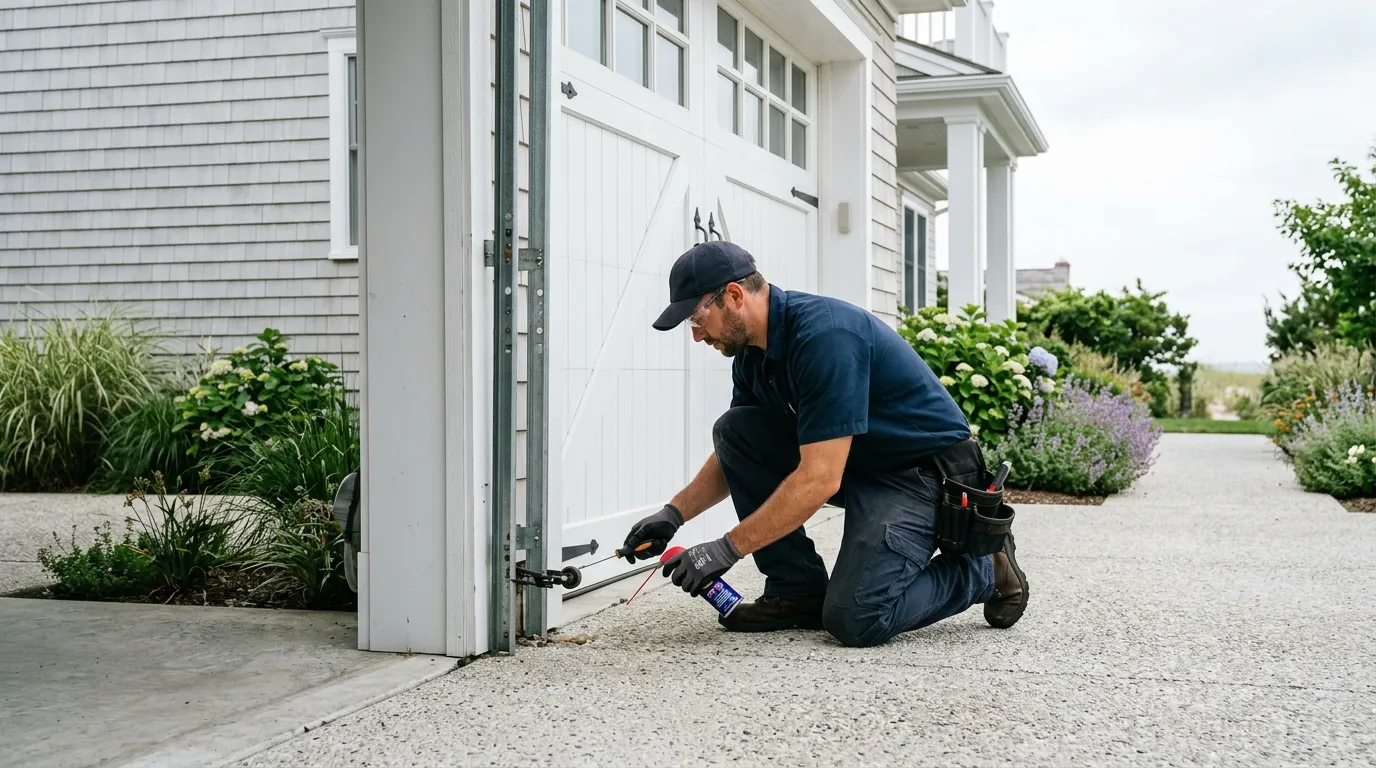
Woodlyn's houses mostly went up around 1957, and that one number explains most of what we find when we open a call sheet from this town. Homes built in that stretch came with steel doors on torsion springs mounted the old way - a single center spring on a shaft, not the two-spring setup that's been standard since the 1970s. When that single spring goes, the door doesn't just squeak, it drops hard, and a lot of owners call us thinking the opener died when it's really the spring. We also see a fair number of openers that were bolted onto original hardware decades after the door itself was installed, which means the safety sensors and the travel limits were never really matched to the door's actual weight. With 4,196 households in Woodlyn, we're not talking about a huge, varied housing stock - a lot of these driveways share the same builder-grade door and the same failure points, which is part of why the same three or four repairs come up again and again on this street pattern.
We don't keep a truck stationed in Woodlyn. The shop is in Cherry Hill, about 17 miles out, so when you call, you're booking a trip, not a knock on the door in ten minutes - we won't pretend otherwise. We also don't push full replacement on a door that just needs a spring, a cable, or a set of rollers; a lot of the 1950s-era doors in this town are structurally sound steel that outlasts the hardware bolted to them, and swapping the whole unit when the panel's fine is money you don't need to spend. At a median household income of $71,978 in Woodlyn, we know a $150 spring job and a $1,400 door replacement aren't decisions people make lightly, so we tell you which one you actually need before we quote either. What we won't do is guess on parts for a door we haven't seen - original hardware from this era sometimes isn't a stock item, and if that's the case, we say so instead of promising a same-day fix we can't deliver.
The median year built in Woodlyn is 1957, which puts most of the neighborhood squarely in the postwar building wave that ran roughly 1938 to 1997 across this part of the service area, with the bulk of it - like here - landing well before 1960. That matters more for garage doors than for almost anything else in the house, because door and opener technology changed more between 1957 and today than framing or roofing did. A house built in 1957 was built before automatic openers were common at all; most of these garages started with a manually lifted door, and the opener, the torsion hardware, even the track width were added or swapped out later, sometimes more than once. That layered history is why two houses on the same block can have completely different setups even though the houses themselves look nearly identical. It's also why measuring the actual hardware in front of us matters more than assuming based on the house's age - the door might be original, or it might be the third one that block has had.
In practice, the 1957 build date shows up as narrower door openings than newer construction, single torsion springs instead of paired ones, and tracks that were shimmed or re-hung by hand rather than installed to current spec. None of that is a defect - it's just older, and older hardware wears differently. A single spring under a heavier insulated replacement panel works harder than it was ever sized for, which is a common reason doors in this kind of housing stock feel heavy or slam on the way down years before the spring itself technically fails. Cables on this era's doors also tend to be shorter runs with older-style drum sizes, so a like-for-like cable swap isn't always a shelf item - sometimes it has to be cut to match. None of this is a reason to avoid fixing what's there; it's a reason to have someone look at the actual hardware before quoting a repair over the phone. This is also the honest limit of what we can promise sight-unseen: on a house this age, the fix depends on what's actually on the wall.
No. We run out of Cherry Hill, about 17 miles from Woodlyn, and we travel out for jobs rather than keeping a truck stationed here. That's worth knowing when you're timing a repair against a broken spring holding a door shut.
Often it's worth fixing. A lot of the steel doors from Woodlyn's 1957-median building wave are still structurally sound; it's the spring, cable, or rollers that fail, not the panel. We'll tell you honestly if the door itself is the problem, but usually it isn't.
On houses from this era, a single torsion spring was often sized for a lighter original door. If that door was later swapped for a heavier insulated panel, the same old spring is working past what it was built for, and that shows up as a door that feels like it's fighting you.
Call now or request a free quote - same-day service on most repairs, upfront written pricing.